Home » Magazine » Rebuilding Trust in Climate Action Through Clean Cooking
Rebuilding Trust in Climate Action Through Clean Cooking
Across cultures, the kitchen is often the center of the home. It is where meals are prepared, conversations unfold, and traditions are passed from one generation to the next. Cooking is deeply tied to care, culture, and daily life.
Yet for more than two billion people worldwide, cooking remains a major source of environmental and health risk.
In many regions across Africa, Asia, and Latin America, households still rely on wood, charcoal, and kerosene as their primary cooking fuels. These traditional methods produce dense smoke that fills kitchens and living spaces, exposing families to harmful pollutants every day. According to global health estimates, household air pollution causes around 3.2 million premature deaths each year, making it one of the most significant environmental health threats worldwide.
The climate implications are equally serious. Traditional cooking practices contribute an estimated two percent of global carbon emissions. At the same time, the demand for firewood drives forest degradation in many regions, placing additional pressure on ecosystems already under stress.
For millions of families, the burden extends beyond health and environmental impacts. In many communities, women and girls spend hours each day collecting firewood, often traveling long distances and sacrificing time that could otherwise be dedicated to education, income generation, or rest.
These intersecting challenges—climate, health, gender inequality, and forest loss—have made clean cooking one of the most important yet under-recognized opportunities in global climate action.
At the same time, a broader challenge has emerged within the climate finance landscape: the need to rebuild trust in carbon markets.
A Moment of Reckoning for Carbon Markets
Carbon markets were created to channel capital toward emissions reductions by assigning financial value to avoided or reduced greenhouse gases. Through carbon credits, organizations can compensate for unavoidable emissions while financing projects that deliver climate benefits elsewhere.
In theory, this mechanism enables climate action to scale.
In practice, however, the voluntary carbon market has faced growing scrutiny in recent years. Questions about transparency, methodological assumptions, and the accuracy of emissions reductions have raised concerns about the credibility of some carbon credits. When climate benefits cannot be independently verified, the legitimacy of the system itself comes into question.
This credibility gap has triggered an important shift in how climate projects are evaluated. Increasingly, investors, corporations, and regulators are demanding higher standards of measurement, verification, and traceability.
The future of carbon markets will likely depend on solutions capable of demonstrating impact with far greater precision.
Clean cooking technologies are emerging as one such opportunity.
From Household Appliance to Climate Instrument
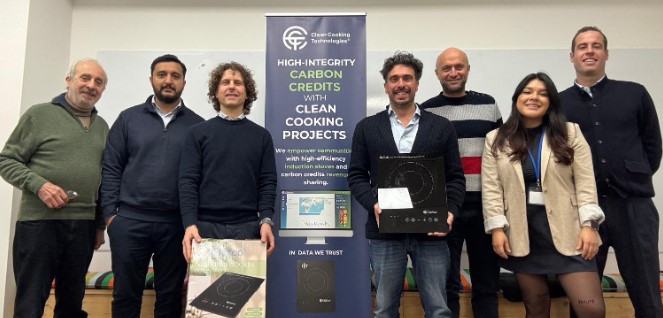
Clean Cooking Technologies is a climate technology company founded in 2023 with the goal of accelerating the transition to modern electric cooking systems in regions where households still rely on biomass fuels. The company works across Africa and Central Asia, deploying electric induction stoves and pressure cookers designed to eliminate the need for firewood and charcoal.
While electric cooking itself is not new, the company’s model integrates digital monitoring systems that allow climate impact to be measured in real time.
Each stove is equipped with Internet-of-Things (IoT) sensors that track usage data, including cooking duration, energy consumption, and frequency of use. This information is securely transmitted and analyzed to estimate the emissions reductions achieved when biomass cooking is replaced with electric alternatives.
Because these measurements are based on actual usage data rather than generalized assumptions, the resulting emissions reductions can be calculated with greater accuracy. When combined with secure data infrastructure, such as blockchain-based verification systems, this approach allows carbon credits to be linked directly to measurable performance.
In effect, a household appliance becomes a climate monitoring device.
Each cooking session produces data that contributes to a transparent record of emissions reductions. Over time, this model transforms an everyday activity—preparing meals—into quantifiable climate action.
Beyond Carbon: A Systemic Impact
While the climate benefits of clean cooking are significant, the broader development impact is equally important.
Replacing biomass cooking with electric alternatives dramatically reduces indoor air pollution, improving respiratory health and lowering the risk of chronic disease. Cleaner kitchens particularly benefit women, children, and elderly family members who typically spend the most time near cooking areas.
Environmental gains also extend to forest protection. Reduced demand for firewood helps slow deforestation and preserves biodiversity in regions where forests are under growing pressure.
Perhaps most transformative is the social impact associated with time savings. When households no longer need to spend hours gathering fuel, women and girls gain time that can be redirected toward education, employment, and community leadership.
Because clean cooking touches multiple dimensions of sustainable development simultaneously, it contributes to a range of global priorities—from climate mitigation to health, gender equity, and sustainable resource use.
This multidimensional impact reinforces the value of clean cooking as both a climate solution and a development intervention.
Financing the Transition
Despite the clear benefits, scaling clean cooking technologies remains a major challenge. Upfront costs, infrastructure limitations, and financing barriers often prevent households from accessing modern energy solutions.
To address this, new financial models are emerging that combine technology deployment with carbon finance.
Clean Cooking Technologies operates through partnerships with corporations, manufacturers, and investors seeking high-integrity climate solutions. Companies can support the deployment of clean cookstoves as part of their broader decarbonization strategies, generating carbon credits linked to verified emissions reductions.
Another important mechanism is the pre-financed carbon credit model. In this structure, future carbon credits are sold in advance, generating the capital needed to deploy cookstoves at minimal or no cost to households. This approach allows climate finance to directly support energy access, while investors receive long-term environmental value.
By embedding monitoring and verification directly into the technology, the system ensures that carbon credits are tied to real-world usage rather than theoretical projections.
This shift—from estimation to measurement—may prove critical for the credibility of carbon markets moving forward.
Restoring Confidence Through Measurable Impact
Today, Clean Cooking Technologies has deployed more than 1,200 electric cookstoves across multiple countries in Africa and Central Asia, reaching over 6,000 people and preventing more than 1,000 tons of carbon emissions in the past year alone.
Each installation represents a small but meaningful shift: from smoke-filled kitchens to clean air, from hours spent collecting wood to time gained for other opportunities, and from estimated climate benefits to measurable emissions reductions.
As the climate finance ecosystem evolves, trust will increasingly depend on transparency and data-driven verification. Solutions that can demonstrate impact in real time—while also delivering tangible benefits for communities—will play a critical role in rebuilding confidence.
Clean cooking technologies offer a powerful example of this emerging model.
By linking everyday human activity with verifiable climate outcomes, they illustrate how climate solutions can operate simultaneously at the scale of households and global markets.
In the search for credible pathways to accelerate climate action, the answer may lie in places often overlooked. Sometimes, the most powerful climate solutions begin in the kitchen.
To learn more about Clean Cooking Technologies and explore partnership opportunities in scalable clean cooking and high-integrity carbon credits, visit clean.cooking.